Adorable Chaos, Strategic Depth
It feels strange to review Glassbreakers now. We first covered it two years ago after it came out of a Closed Beta. After going public for a while as a free-to-play game, it disappeared! Polyarc, the makers of Moss, took it back onto their forge and worked on it like cute little battle-hardened mice. And now, lo and behold! Two years later, the Moss-world-inspired RTS/MOBA hybrid VR game is back on the stage, mustering its cute little creatures to compete for your attention in a world perhaps more excited by Triangle Factory's fantastic Forefront and Twisted Pixel's less-than-stellar Deadpool.
The reborn Glassbreakers launches as a premium title at $19.99 across Meta Quest, Steam, and Apple Vision Pro with full cross-platform play—a notable pivot from its free-to-play beta roots.
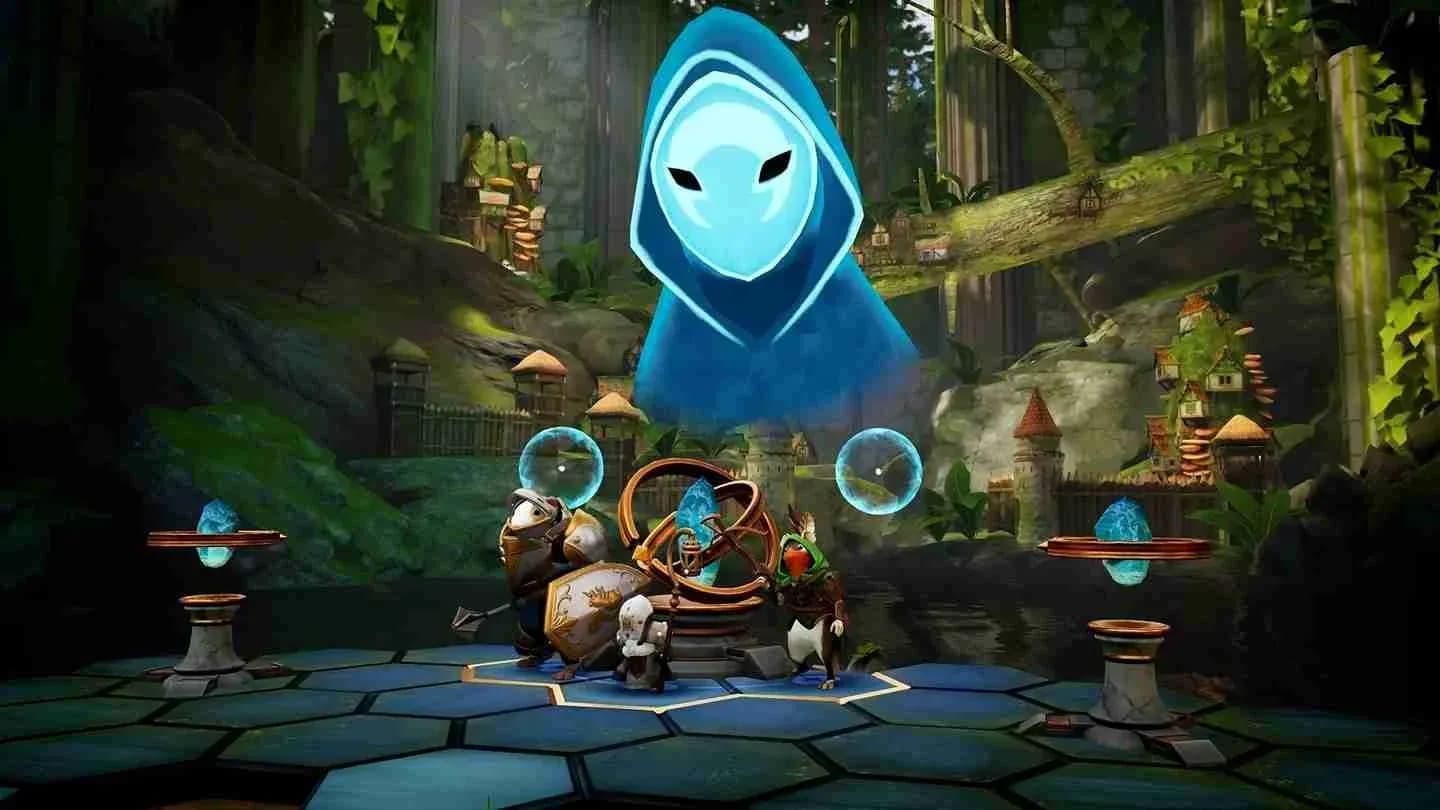
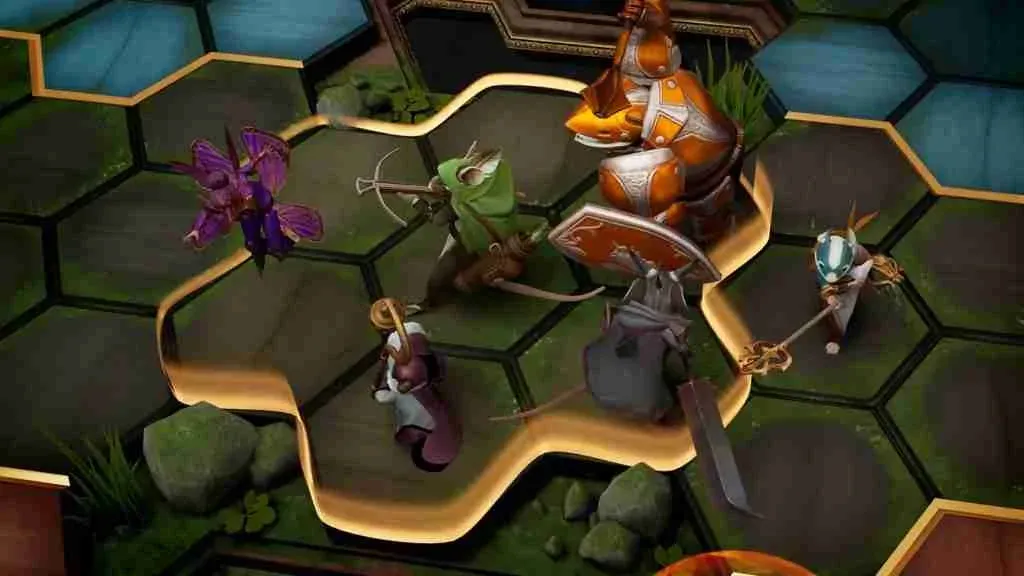
Glassbreakers pits two players against each other in one of four arenas. Each player controls a team made up of three characters, selected from a roster of 12 characters that you can unlock by not sucking too badly. Each character has a balance of attributes: health, attack strength, and special ability power. I'm not sure that's what the game calls the attributes, but hey—this is my review, and I get to use words.
But here's where things get interesting: team composition matters. A lot. With 12 champions offering 220 possible three-character combinations, you're not just picking your favorites—you're crafting synergies. Some champions excel at aggressive pushes, others at defensive turtle strategies, and still others at map control and denying your opponent those crucial power-ups. Your playstyle shifts dramatically based on who you're fielding, which means you're constantly adapting your approach match to match. It's a deeper layer than it first appears.
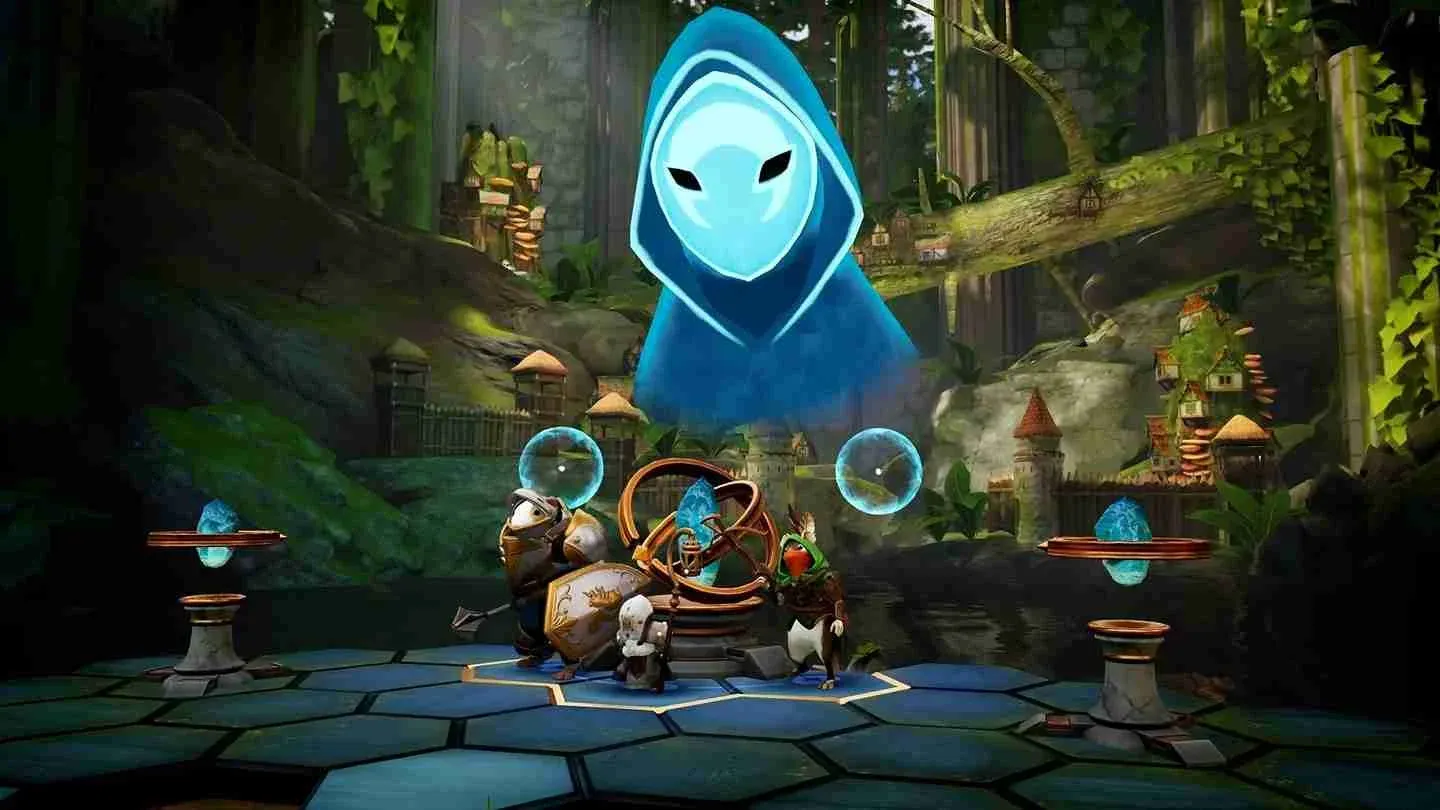
Of course, since it's so character-based, the game provides some niceties. You have skins, you have color themes, etc. So you can play dress-up. Sweet. You can also change the color of your banner and the color of your own avatar and the mask you have on. It's fun. Colorful. Cool.
But how do you win, you ask? Do you just beat the crap out of the other team?
Well, yes. You do, but it's a little more involved than that. Each player has three glasses. There's your main glass, which is essentially your headquarters and your healing center. On both sides of your main glass base, you have two other glasses, which function as your defensive turrets but whose destruction opens the door to defeat.
So here's how it goes. The game, like life, runs on a timer. You have no time to waste! Time is of the essence, and all that. If you destroy the other player's main glass, you win! If you don't, then when the timer runs out, whoever has the most glasses standing is the winner! If you both have the same number of glasses, it goes into overtime, and if you both survive overtime with equal glasses, then whoever has the most shield points left wins. The other player? They're history, forever destined to live a life of shame and regret. It's tough when life goes bad for an otherwise cuddly little creature.
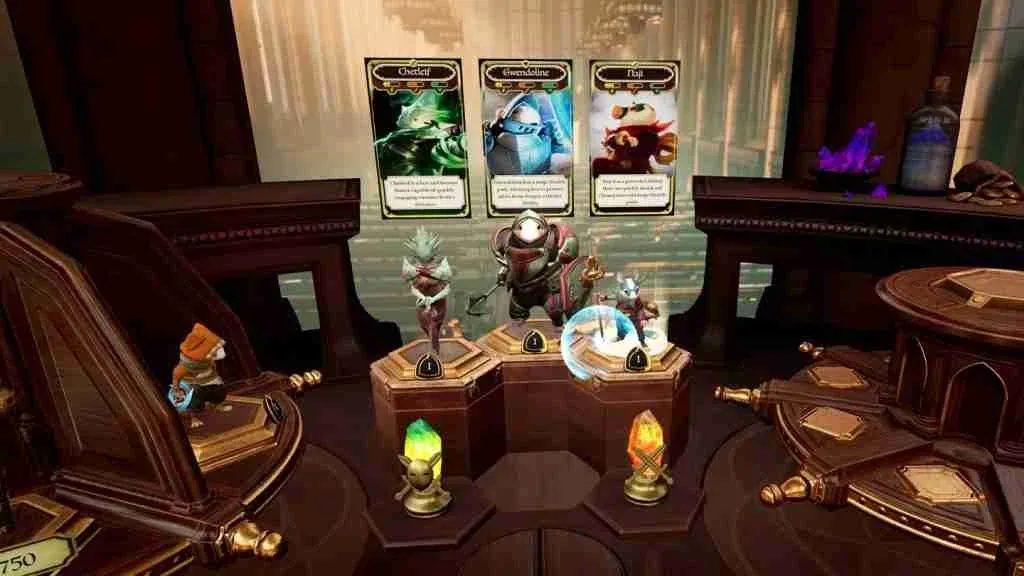
Look, it's all really great fun, unless, as Doc, you're just not into this sort of game. I love it, Pete loves it, and my 11-year-old son loves it too, so basically, all the cool kids dig it.
Now the game has much more nuanced mechanics. Your characters get stronger as they land more kills during the game, giving it a momentum-based angle. The more you win, the easier it is to win. So you're on edge all the time, trying to eke out kills without getting killed yourself. It's a delicate balancing act, which really gives the game a strong ebb and flow as you land a kill or two, then rush back to the base to defend yourself and heal. But the hexagonal map itself has power-up spots that, if you occupy, can spawn power-ups that augment your health, your attack strength, or your special ability cooldowns. So you're also driven to race and fight for those. Once spawned, you can give them to any of your characters, each of which can be equipped with four of them.
Did I mention the sway glass? Whoever destroys it has extra glass-smashing power. Hence, sway.
Case in point: I was playing against Pete the other day, and I really thought I had him on the ropes. I'd whittled down his side glasses, my squad was stronger, and victory felt inevitable. But he deftly managed to turn the tide with some clever positioning and a last-second assault on my main glass that snatched victory from my grasp. We both had to conclude: there are no ropes in Glassbreakers! The momentum can shift in an instant, and matches that feel decided at the 7-minute mark can flip completely in the final 30 seconds.
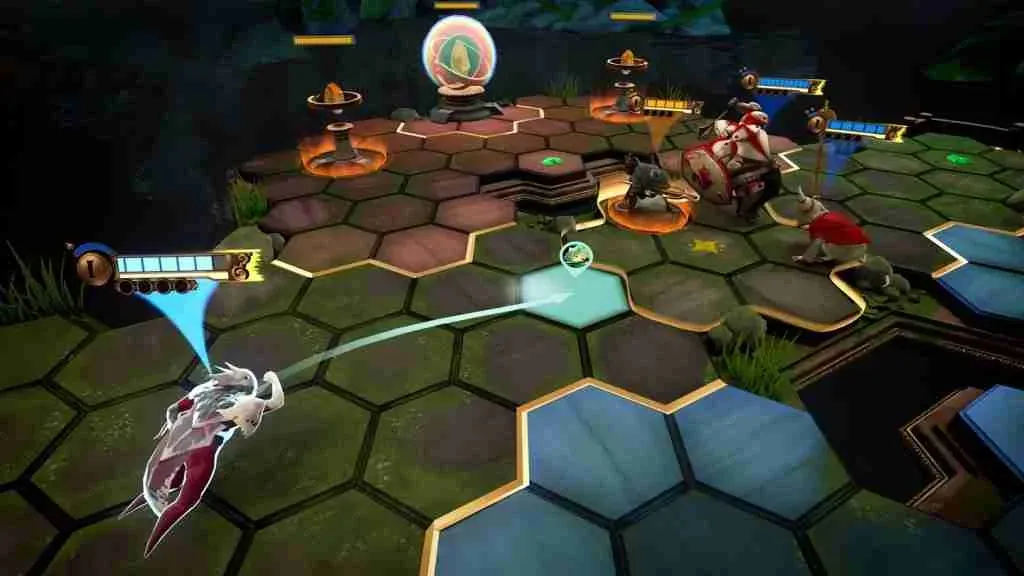
Now put all those elements together and you end up with an intricate game of strategy and a lot of ways to win. It all comes together to give you a game that looks cute but offers surprising gameplay depth. You can play traditional 1v1 matches, or jump into "Buds Mode" for 2v2 and cooperative team play, which adds yet another layer of tactical coordination.
When it comes to visuals, let's just say, Polyarc.
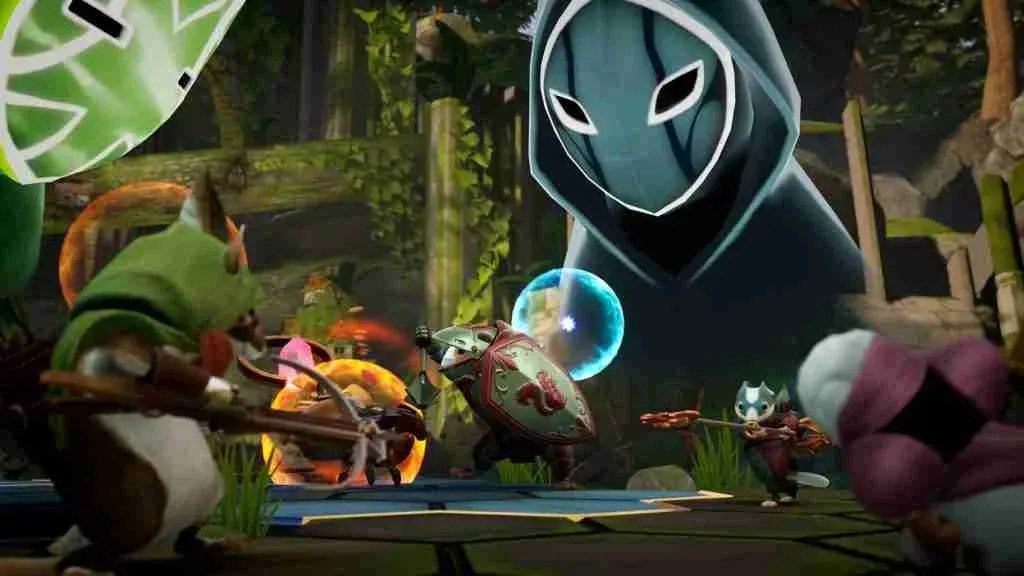
If you've played Moss 1 or Moss 2, then you've already experienced the colorful cuteness that Polyarc so graciously and deliciously pours wholeheartedly into their creations. Glassbreakers is no exception. The champions' character designs and animations are easily the star of the show here. They're animated beautifully and exhibit a great deal of character. It's easy to fall in love with all of them, and so, yes—even grown men, especially Pete, like to dress them up in different skins and colors and change them up to see which teams form more formidable combos. It's all good, clean fun.
The environments are less impressive but are still colorful, moody, and, perhaps more importantly, unobtrusive. Most are well designed for the gameplay, although I still have my doubts about the asymmetrical icy wastes one.
The UI is generally polished but has some small glitches, such as the character levels not appearing identical to both you and your opponent on the intro screens, but this has zero impact on gameplay.
Overall, it's a pretty game with beautiful character design and animations.
Less impressive is the audio. There's nothing wrong with it, and Morla Gorrondona, who wonderfully voiced the narrator in Moss, is basically the MC here in Glassbreakers, and she does a great job, but doesn't have much to work with in a game bereft of narrative. More importantly, the game's sound design and battle sounds are on point. You're never confused about what's going on, so on that level, it succeeds.
The music is very much what you'd expect—fantasy-battle, I guess is the genre—but it does get repetitive if you pay attention to it, which, to be honest, I don't. It's not the star. I am, me and my champions!
Remember when Kevin Costner built that baseball field and they came? Well, this might be Glassbreakers' biggest stumbling block. Polyarc has built the damn game, but it seems not enough of you dreary lot are playing it! I am old enough to shake my fist at the clouds and wonder why!
The only real weakness Glassbreakers has right now is that not enough players seem to have adopted it, so you'll often find yourself paired with a bot. Now, I don't want to anger Skynet in its infancy, but playing with bots isn't half as much fun as pummeling real-life people and reducing grown men to tears. The cross-platform play between Quest, Steam, and Apple Vision Pro should help populate the servers, but the game needs time to build its community.
To be fair, there is an active Discord community where you can arrange matches with real humans, which is great if you're willing to coordinate. But the servers aren't populated enough that you can just pop on at 2 AM on a Tuesday and expect to find a match. You'll need to either plan ahead or accept that your opponent might be running on algorithms rather than adrenaline. I wish they had a toggle to only match me with real players instead of defaulting to a bot after a set time, but I understand why that's the case right now. The solution, of course, is obvious—play Glassbreakers so I can reduce you to a miserable puddle of jelly.
All kidding aside, Glassbreakers, like all multiplayer games, will live or die based on player adoption, and right now, it's not looking so great. I don't even like saying this because I'm worried it'll dissuade you from giving it a shot, but hey—be the change you want to see, said the balding villain.
Glassbreakers is marred only by the absence of a large community and the fact that, to be Gehry, it doesn't really need to be in VR. Don't get me wrong—the tactile controls of reaching into the board and physically directing your champions adds something to the experience, and facing your opponent across the table brings a psychological element that flat gaming can't match. But the core gameplay could translate beautifully to a traditional PC or console experience. I actually think one of these problems is the solution to the other. MOBAs probably do better on PC than in VR, and I genuinely believe Polyarc should make a flat version of Glassbreakers ASAP. If it's cross-platform, it would massively help populate the servers for those of us who want to play in VR.
It's also a game in sore need of a friends list. Polyarc, seriously—I shouldn't need to call my friend out of the game to get a code to join his party. Give us proper social features and make this easier. It's 2025.
Despite these concerns, Glassbreakers is a wonderful RTS/MOBA hybrid with fantastic character designs and animations, nuanced game mechanics, and, if you can find the people to play against, almost infinite replayability. It's a shame it's not as popular as it should be, and I'm baffled by the lack of coverage and enthusiasm toward it in the Meta Quest YouTube community, but hey, you heard it here, folks!
As an Amazon Associate we earn from qualifying purchases. Prices and availability may vary.