When It Soars, It Soars
Despite the impressions you might have had from the pre-release marketing. Reach is not purely an all-out, bows-brandished action romp. Don't get me wrong, it is that, but it's also something else entirely.
At its core, Reach is actually a narrative-driven platforming puzzle adventure, with elements reminiscent of classic Tomb Raider or Prince of Persia gameplay.
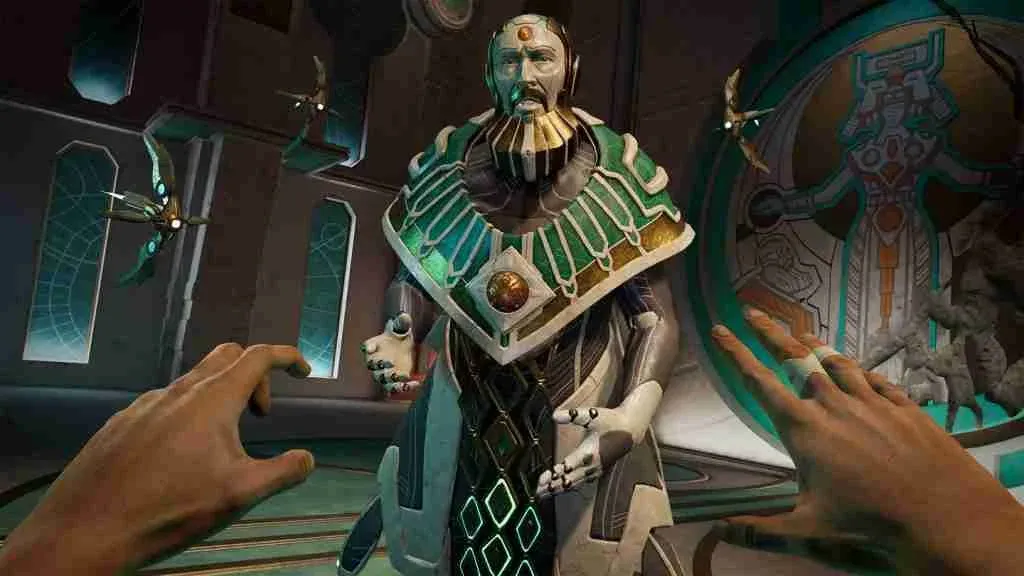
You play as Rosa, a Hollywood stunt double whose life takes a dramatic turn when a cataclysmic event strikes her film set, sending her plummeting into the mysterious subterranean world of Ferra. There, she encounters Atlas, a living statue who serves as both guide and companion on a journey to prevent humanity's extinction.
The story is simple but elegant. It never drowns you in exposition, instead letting you explore the world's architecture while the narrative unfolds around you. Reach treads the line between sci-fi and fantasy, evoking both alien ruins and ancient temples. The tone is cinematic without feeling heavy-handed—a delicate balancing act that the writing and voice acting pull off well.
Ferra itself feels well established. It's a layered, vertical world of ancient machinery, glowing glyphs, and impossibly tall platforms that dare you to leap. The lore reveals a civilization long gone while leaving just enough mystery to keep you curious as the plot evolves throughout the roughly nine-hour campaign.
It's a world worth falling for, even if, at times, that falling is more literal than intended.
Gameplay in Reach revolves around movement, spatial puzzles, and fluid combat, and when it's firing on all cylinders, it's genuinely spectacular.
The heart of the game lies in its unique platforming: a parkour system built on climbing, vaulting, grappling, and leaping between massive structures suspended over dizzying chasms. Usually, I find climbing in VR tedious. Outside of The Climb series, it's rare that this kind of traversal feels like anything more than busywork, but Reach absolutely nails it. Whether you're attempting to launch yourself to a seemingly out-of-reach handhold or frantically climbing a structure as it crumbles into an abyss around you, climbing here feels fluid and physical.
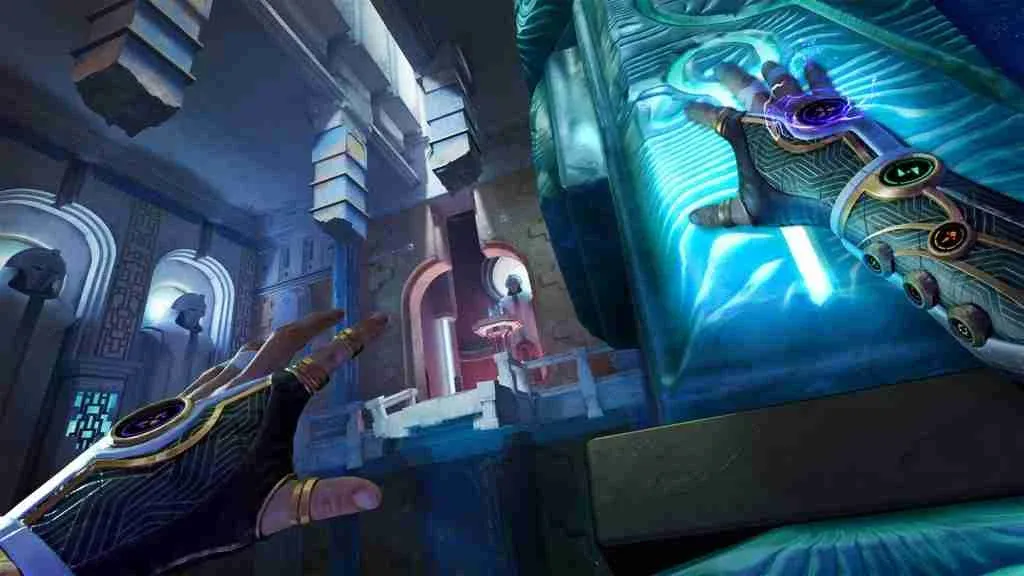
You'll scale walls using hand-over-hand climbing, fling yourself across impossible gaps, and even launch into mid-air parkour sequences that feel properly cinematic. Puzzles are largely spatial "action puzzles," requiring you to use the various traversal skills you've acquired to reach certain areas. This can range from direct, skill-based platforming to more intricate puzzles that involve moving objects around to enable you to further parkour your way through the level. The game cleverly ties this physicality to progression; as you move deeper into Ferra, Rosa's gauntlets unlock upgrades, allowing for faster, more versatile traversal that affects both combat and puzzle-solving.
The jump mechanics also deserve special mention. Rather than just a simple button press, jumping is triggered by including a quick arm-lift gesture too (very reminiscent of Stride), and I think it's one of the most satisfying ways to move in VR. The unconscious embodiment that this brings about is intrinsic to your immersion in the world, and once the system clicks, it becomes second nature.
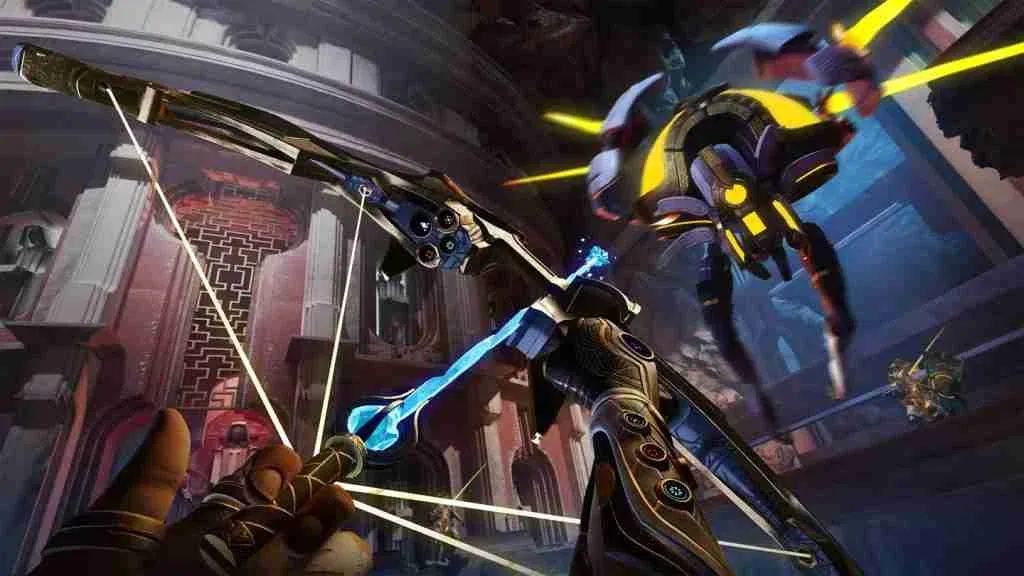
You'll find yourself making small flicks to quickly hop and vault through the more sedate sections but then unintentionally throwing your arms up wildly when it's time to make one of those enormous leaps.
It's bloody brilliant—when the systems behave.
Unfortunately, that's the caveat: when they behave. Frame rate stutters, momentum glitches, and janky sprinting occasionally turn thrilling sequences into exercises in frustration. A memorable early-game chase sequence through a collapsing structure would have been breathtaking if not for repeated control drops that cost me several lives. The systems aren't poorly designed; they're just undermined by inconsistent performance.
When everything aligns, Reach is one of the best action-platformers VR has ever seen. When it doesn't, it's a masterclass in frustration.
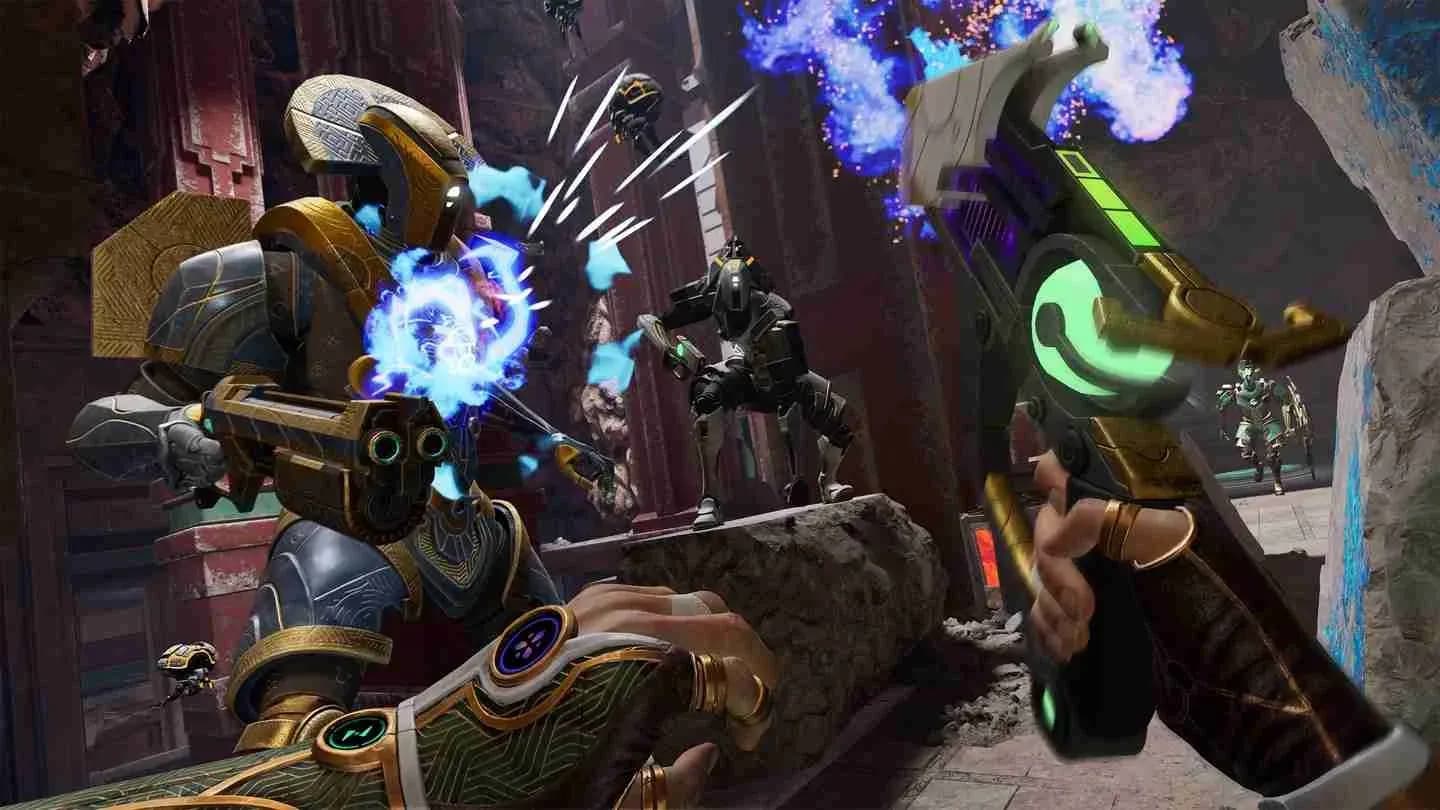
Combat in Reach is administered via an excellent array of tools: an energy bow that slings over your shoulder, a gesture-summoned shield that makes you feel like Captain America, and a set of grapple drones that allow you to move through the levels with speed and precision. As you progress, you unlock new arrow types (explosive, freeze, and stun) which expand your tactical options and provide a brilliant flow state to the combat.
At its best, combat feels smooth, cinematic, and empowering. Deflecting projectiles with your shield, then ricocheting it off walls to stun an enemy before finishing them off with a precision arrow to the face—it feels incredible. It's fast, physical, and responsive, and frankly, I would be happy if there were more of it.
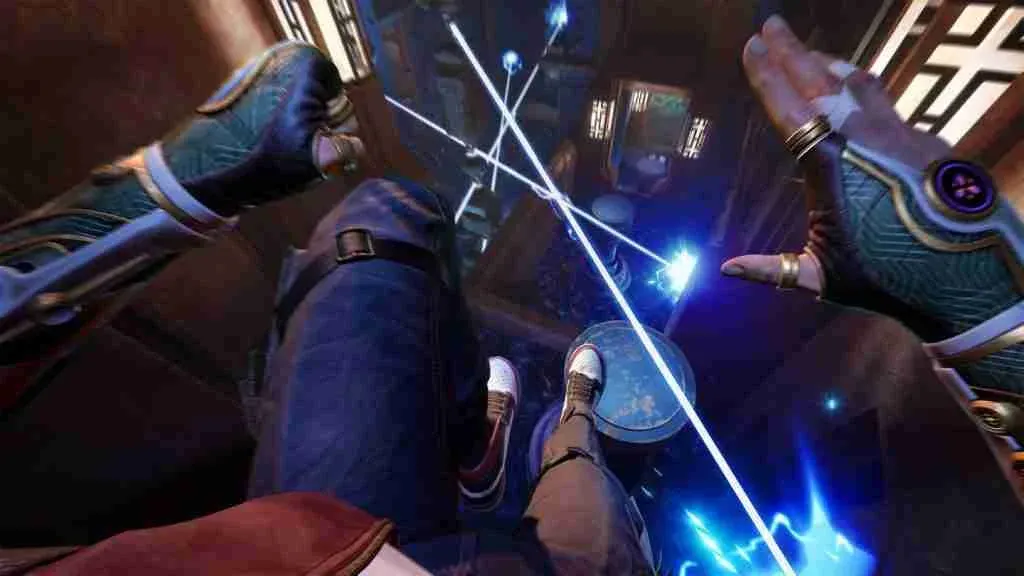
Action sequences are not, however, the main focus of the game but are instead metered out as a staccato counter-rhythm to the platforming and spatial puzzle sequences, and the pacing overall is very effective. Just as you start to get tired of climbing and vaulting, you find yourself in the thick of an immensely satisfying battle. These battles are spaced out just enough so that you look forward to them and to prevent you from noticing just how few enemy types there are and thus beginning to tire of the action.
The reality is that were combat the focus of the gameplay, one might well consider it lacking depth. But once I adjusted my expectations and understood the role it plays in the game, I found the combat to be entirely adequate.
From a purely artistic standpoint, Reach is stunning.
The world of Ferra is built on a foundation of vertical grandeur: vast caverns threaded with alien machinery, gleaming ruins illuminated by cascading light. The art direction strikes a great balance between realism and abstraction, creating something that feels both ancient and futuristic.
Textures on the Quest can appear a little grainy up close, and nDreams has taken a heavy-handed approach to the use of ASW, which can get distracting. But despite this, the game's overall visual presentation still hits a fairly high bar. The scale alone is consistently impressive; some of these vistas, particularly as you scale them, genuinely make you catch your breath.
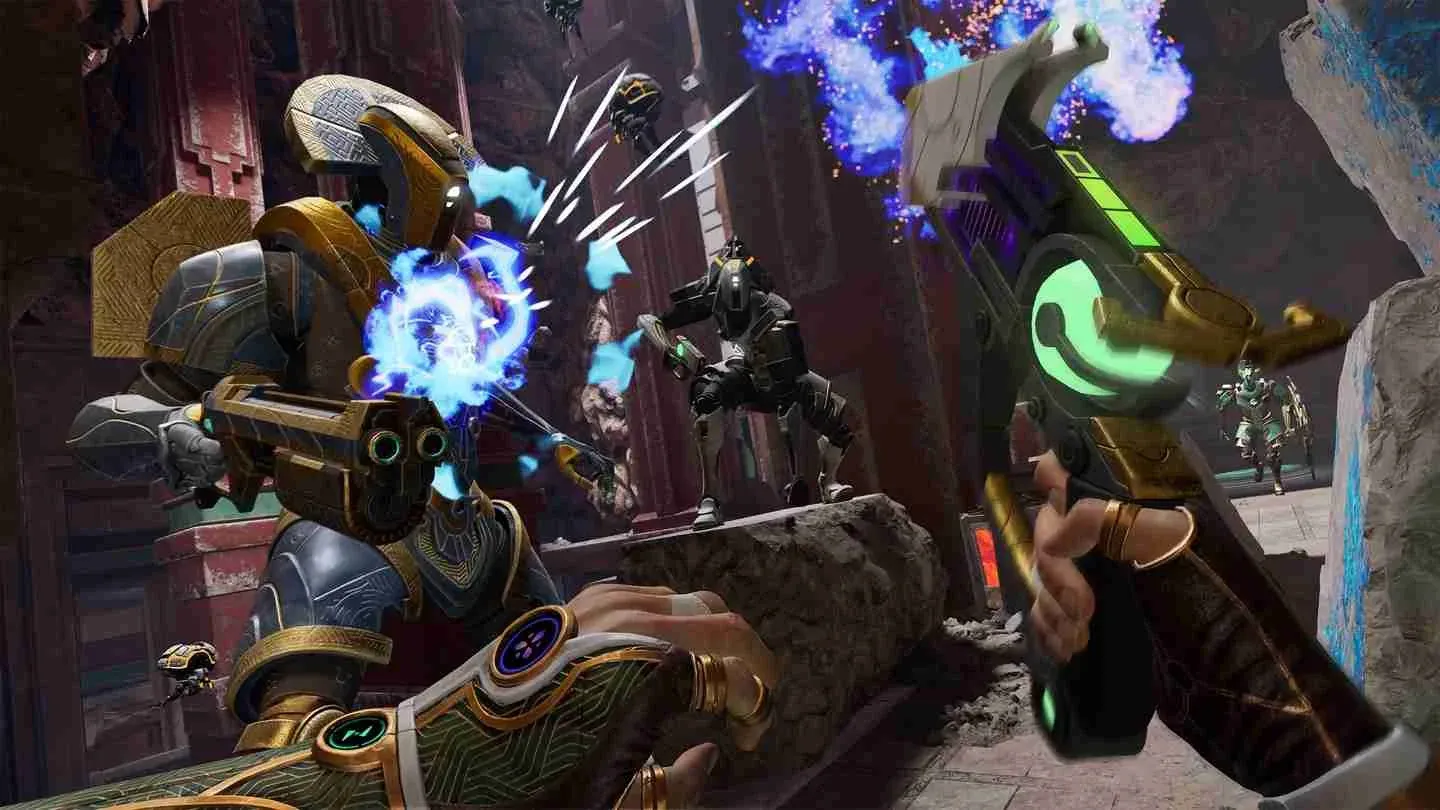
That said, the price of beauty is performance. The Quest version constantly dips into choppy frame rates, with egregious pop-in and stuttering that is not just reserved for larger set pieces. In fact, this is so consistent as to become an unavoidable feature of playing the game.
This is unfortunately where Reach in its current state might be better dubbed "Overreach." The hugely ambitious scope this game tries to deliver may have been more than the developers could manage, and these performance issues have a severe impact on the experience.
I love the gameplay elements of Reach so much that I was able to push through, but the performance really marred the experience for me. Honestly, had I not been rushing through to deliver a timely review, I would have put the game down after the first hour and waited (impatiently) for some performance fixes to land.
If there's one element of Reach that is beyond reproach, it's the sound design.
From the moment you enter Ferra, the game envelops you in an audio landscape that feels alive. The ambient soundscapes, the cinematic rise and fall of the score—it all works harmoniously to make the world feel tangible.
The voice acting is understated but effective, selling Rosa's vulnerability and determination without drifting into melodrama. Atlas, your enigmatic companion, delivers his lines with just the right mix of gravitas and warmth, grounding the story's more fantastical moments.
Weapon and ability sound effects are meaty and satisfying: the hum of a charged arrow, the thump of a shield strike ricocheting off stone. Even the small things, like being alerted to the presence of a nearby energy grub by the soft skittering noise they make—it all works to ensure the game uses every available sense to draw you into the world.
Reach offers a roughly nine-hour campaign, though your mileage will vary depending on skill and patience with its platforming challenges. For most players, that's a healthy length—long enough to tell a complete, satisfying story without overstaying its welcome.
The downside is that there's little to do once the credits roll. There's no post-game content, no challenge arenas, no unlockable modes. In an era where games like Asgard's Wrath 2 and Batman: Arkham Shadow extend their lifespans with bonus combat trials or roguelike modifiers, Reach feels like it ends just as you've fully mastered its mechanics.
It's a shame, because the core gameplay systems are rich enough to sustain extra combat modes or time-trial content. Even simple incentives like New Game+ or the ability to select specific levels to try again would have gone a long way toward encouraging another session.
As it stands, Reach delivers a brilliant but finite experience. You'll finish it with a sense of accomplishment but also a tinge of regret that there's no reason to return, at least not yet.
There's a heartbreaking irony at the center of Reach. It's a game that reaches high—for cinematic immersion, mechanical depth, and engrossing storytelling—and in so many ways, it succeeds.
When everything is working, Reach delivers some of the most thrilling moments I've experienced in VR: scaling impossible towers and leaping across collapsing bridges while being chased by huge monstrosities; leaping into the air and flinging my shield into a crowd of frozen enemies and watching it ricochet between them, shattering them into tiny pieces; and all while a swelling, cinematic score drives me forward. It's smart, physical, and exhilarating.
But it's also inconsistent. The technical issues—performance drops, control bugs, and platform instability—are simply too frequent to ignore. They undercut what should have been a triumphant moment for nDreams, and I hope the studio will recover quickly from a rocky launch.
As much as I hate to do it, for now, I'm scoring Reach a 7.5 based on the stability of the launch build. But if nDreams can stabilize the frame rates (and minimize the pop-in just a little), I will bump that up to an 8.5 in a heartbeat. If they ever throw in some post-game content, like combat missions or time-trial platforming courses, Reach would easily shoot to a 9. Let me tell you: if that day ever comes, I'll be first in line to leap back into Ferra.
As an Amazon Associate we earn from qualifying purchases. Prices and availability may vary.